
WATCHMAKER OF SHAPES, MASTER OF CRAFTS


Square, curved, rectangular, or oval. Since the beginning of the 20th century, Cartier watches have established the Maison as the watchmaker of shapes through their signature designs. This year, Cartier is enriching its ever-dynamic repertoire and revealing the essence of its watchmaking expertise through a unique mastery of savoir-faire.
From the most essential to the most expressive, the shapes of Cartier watches all require bespoke craftsmanship adapted to their singular designs. Among them, the Roadster watch is making its grand return. This reinterpretation has been made possible by the ever-evolving expertise of more than a hundred disciplines, brought together in service of its streamlined shape.
Cartier's mastery of watchmaking also draws inventiveness and vitality from its jewellery savoir-faire. This can be seen in the new Baignoire watch, studded with clous de Paris, and the Myst watch, with its precious and sculptural silhouette. These timepieces combine the jeweller's eye with the watchmaker's gestures, creating shapes made sublime with a motif or enhanced further by stone-setting.
An aesthetic quest challenges Cartier to surpass itself, as the Maison merges form and function by creating an extraordinary skeleton movement. Intended for the Crash watch, this shaped movement is a true technical feat, adapted to the irregular case of this cult design.
Everything happens at the Cartier Watchmaking Manufacture in Switzerland, where the Maison's experts cultivate both tradition and innovation. This fundamental approach allows for the invention of a new bracelet for the Santos-Dumont watch, balancing incredible finesse with extreme flexibility.
Through movements, straps, and dials, from the most technical to the most creative, at the 2026 edition of the Watches & Wonders salon, Cartier invites us to delve into the heart of this masterful watchmaking expertise, which allows the Maison to combine and multiply its savoir-faire.
THE SANTOS-DUMONT WATCH: A LEGACY OF INNOVATION
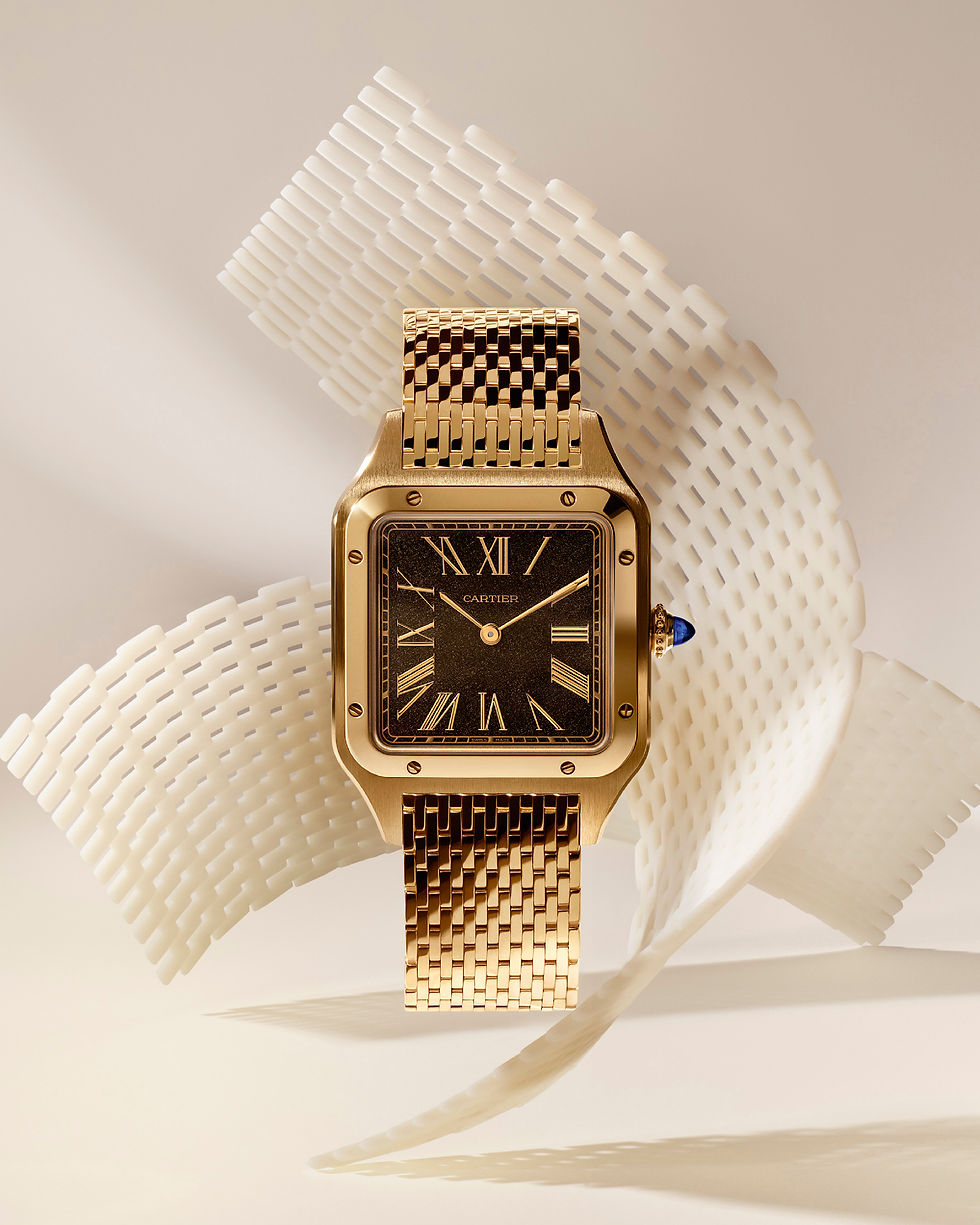
A great classic of the design world, the Santos-Dumont watch has now been reinterpreted with vintage accents, bringing together a wide range of skills at the Cartier Manufacture, from the most traditional to the most innovative.
The Dial: The centrepiece of this new version is its dial in gilded obsidian. This volcanic stone from Mexico owes its iridescent reflections to tiny air bubbles trapped in the material. At just 0.3 mm in depth, its delicacy makes it comparable to glass, posing a significant challenge for the Maison's craftsmen.
The Bracelet: Inspired by the flexibility of the first made-to-measure metal watch bracelets developed by the Maison back in the 1920s, the yellow gold bracelet unfolds with infinite delicacy against the skin. This sensation is due to the ultimate refinement and slim profile of the 1.15 mm links that form the bracelet mesh. Each section is composed of a row of links, for a total of 394 elements all machined, finished, and assembled at the Manufacture.

THE ROADSTER WATCH: TAILOR-MADE IN THE SERVICE OF FORM
The Roadster watch is now making a comeback on the watchmaking scene after its original launch in 2002. The approach to the creation of this new watch focused on redefining proportions, sharpening lines, and rethinking the ergonomics of automobile design.
Design Codes: Borrowing bold codes from the world of mechanical fuselages without altering the streamlined shape or form.
Integration: This is achieved first through design, which strikes a harmonious balance between the bezel and the case with its perfectly integrated crown. The interplay of the crystal and the metal augments the overall shape and unifies the crown, the magnifier, and the dial, which are accented by the calendar aperture and the metal cabochon.
Movements: The Roadster watch is powered by one of two signature self-winding mechanical movements: the 1847 MC for large models and the 1899 MC for medium models.

THE BAIGNOIRE WATCH MEETS THE CLOU DE PARIS
This year, the Maison is reinterpreting the Baignoire watch by adorning it with the Clou de Paris motif, which has been part of Cartier's vocabulary since the early 1920s.
Aesthetic: Crafted in monochrome gold, this motif adds rhythm and structure, magnifies volumes, and creates a truly architectural geometry aesthetic while ensuring continuity between the bracelet and the dial.
Craftsmanship: Drawing on specific expertise, the gold is moulded to preserve the evenness of its shape. The proportions of this new model have been adjusted and reshaped, while the yellow gold push-buttons have been crafted so that they blend into the curve of the bracelet.
Hand-Finishing: The polishing has been carried out entirely by hand with the utmost precision, revealing all its brilliance without wearing down the reliefs.
Diamond Setting: The diamond design showcases the true craftsmanship of the setting via 100 brilliant-cut snow-set diamonds on the dial and inverted pavilion diamonds on the case.

MYST DE CARTIER: PLAYING WITH MYSTERY
The Myst de Cartier watch celebrates the Maison's connection between jewellery and watchmaking.
Architecture: This creation is defined by its alternating curves, domed crystal, and geometric pavé dial, surrounded by a delicate onyx frame with a triangular hour-marker.
Lacquering: Its bold visual elements come together in a symmetry enhanced by black lacquer spots, which have been hand-applied one by one by a craftsman at the Maison des Métiers d'Art in Switzerland.
Gem-setting: The bead setting on the bracelet uses stones of different sizes to create perspective and volume. 112 hours of gem-setting work went into creating this unique architecture.
Innovation: With its lacquered and pavé sections strung on an elastic strap without a clasp, the watch is able to slip onto the wrist thanks to extensive research and development.
"The new Myst de Cartier watch is all about volume and movement. Its design follows in the footsteps of the jewellery watches created under the direction of Jeanne Toussaint in the early 1930s – pieces that were both sculptural and flamboyant." — Pierre Rainero, Director of Image, Style and Heritage
THE CRASH SKELETON: CARTIER PRIVÉ’S 10TH OPUS
Each year, Cartier Privé offers a new interpretation of an emblematic shape from Cartier's watchmaking heritage. For its 10th edition, the Crash, created in 1967 with its asymmetrical dial, has been reimagined in a skeletonised form.
"The first Cartier skeleton watches appeared in the 1920s as pocket watches. A true marvel of elegance and technical sophistication, their design made it possible to render complications visible... This approach reflects the spirit of Cartier watchmaking, where technique is at the service of the aesthetic." — Pierre Rainero, Director of Image, Style and Heritage



Comments