
Campion Platt : The Internationalism of Wellington


For this year’s Holiday House, Campion Platt set out to capture something larger than decoration: the evolving identity of Wellington itself.
“There’s a completely different energy happening here now,” Platt says. “Wellington has become an international community in a way people are only beginning to understand.” For decades, Palm Beach embodied a distinctly traditional vision of American luxury — polished, inherited, and rooted in old-world sensibilities. Miami, meanwhile, carried a different identity, historically tied to tourism before evolving into a global luxury destination.
Today, however, South Florida is undergoing another transformation driven by international wealth, shifting lifestyles, and a growing desire for space, privacy, wellness, and quality of life outside traditional metropolitan centers.
According to Platt, Wellington sits at the center of that evolution. Once defined almost exclusively by equestrian sport, Wellington has quietly emerged as one of the country’s most compelling intersections of international culture, modern luxury, and design-conscious living. Seasonal residents and homeowners now arrive from Europe, Asia, South America, and major U.S. cities, creating a community that feels increasingly global in both taste and perspective.
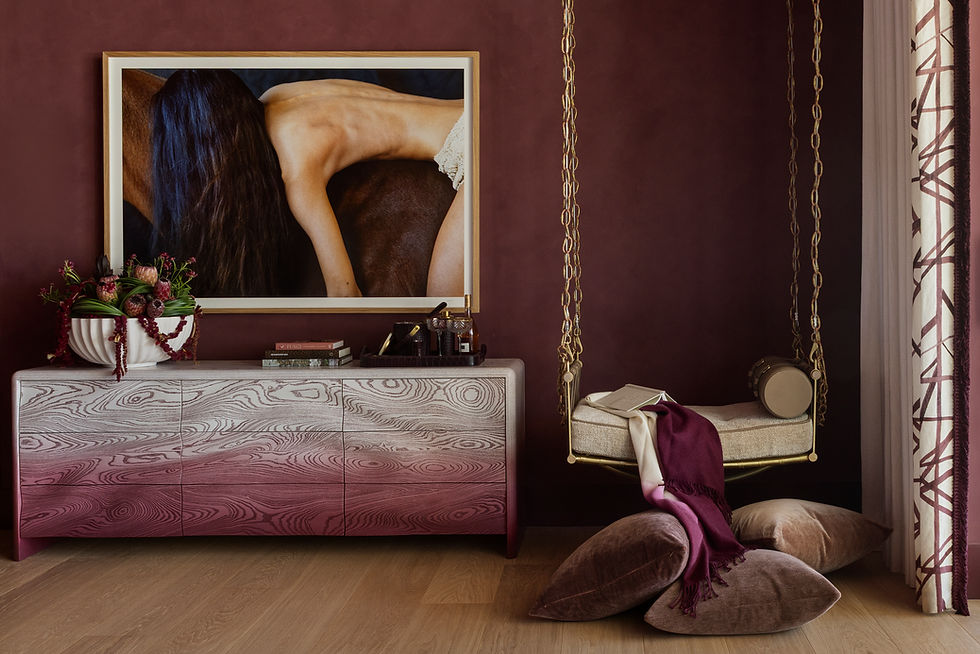
Platt’s Holiday House room, aptly titled The International, reflects that shift. Rather than embracing classic Palm Beach motifs or decorative formality, the space takes a more layered and contemporary approach, combining clean architectural lines, refined textures, nuanced materials, and restrained sophistication influenced by both European and Asian design philosophies.
“There’s a commonality among the people here,” Platt explains. “They come from all over the world, but they share a lifestyle centered around horses, travel, design, and an
understanding of quality.”That international perspective has long shaped Platt’s own
work. Alongside designing hospitality spaces and residences,he has spent years developing custom furniture and cultivating relationships with artisans and manufacturers throughout Asia. His work often balances American innovation with the disciplined restraint associated with Japanese and Asian design traditions — spaces where beauty and functionality coexist effortlessly.
“I’ve always been drawn to design that feels purposeful,” he says. “Things should be beautiful, but they should also make sense.” For Platt, Asian influence is less about ornamentation and more about philosophy: simplicity, proportion, usability, and emotional calm. He believes those sensibilities resonate strongly with a new generation of luxury clients who increasingly value subtlety over excess.
At the same time, he sees America’s creative strength as its freedom from rigid historical constraints. “One of the reasons American design does so well is because we’re constantly reinventing ourselves,” he says. “We’re not as burdened by centuries of tradition, so we innovate more freely.”
That balance between international influence and American reinvention is precisely what Platt believes makes Wellington so exciting right now. As Florida continues attracting global entrepreneurs, investors, creatives, and equestrian families seeking a different kind of lifestyle,
Wellington is evolving into something entirely its own —
less formal than Palm Beach, more relaxed than Miami, and increasingly influential on the international luxury stage.
For Platt, Holiday House became an opportunity to visually express that transition. “This wasn’t about creating a room for me,” he says. “It was about creating a room that reflects what Wellington is becoming.”


Comments